Spray Foam Insulation Guide
What is Spray Foam Insulation?
Spray foam insulation (SPF) is one of the most effective ways to insulate and air-seal a building in a single step. Unlike traditional insulation, which only slows heat transfer, SPF expands on contact to fill gaps, cracks, and cavities — creating both a thermal barrier and an air barrier at once.
Whether you’re insulating new construction, retrofitting an older home, or upgrading a metal building or barn, spray foam helps the whole structure perform as a system. Applied to walls, roofs, attics, floors, crawlspaces, and foundations, SPF keeps conditioned air where it belongs and keeps moisture, drafts, and outside air where it doesn’t.
Here in Pacific County, our marine climate adds a wrinkle traditional insulation doesn’t handle well: persistent moisture. SPF’s air-sealing performance helps reduce the condensation and moisture intrusion that’s common in coastal Washington construction.
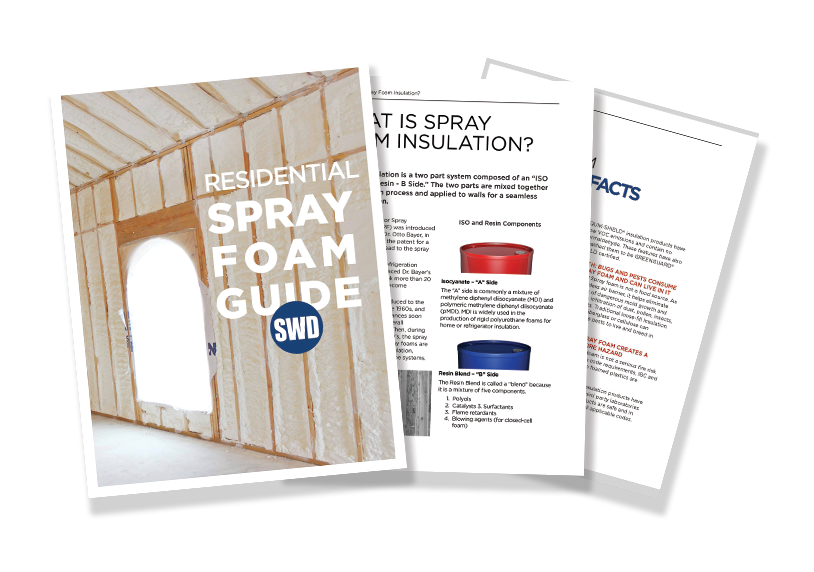
Download the Residential Spray Foam Guide – Click Here
Why Spray Foam Insulation?
Understanding R-Values
R-value measures how well a material resists heat transfer – the higher the number, the better the insulating performance. Actual performance in your home depends on your construction type, climate, and HVAC system, so R-value is a useful benchmark, not the whole story.
Click here to see recommended Home Insulation R-Values
Common Air Leaks vs a Sealed House


Up to 40% of a building’s energy is lost through air leaks, driving up utility bills year-round. Since heating and cooling account for nearly half of a typical home’s energy use, sealing those leaks has an outsized impact — spray foam’s dual role as insulation and air barrier can cut HVAC sizing needs by up to 35%.
Common leak points that spray foam seals effectively:
- Attic hatches and knee walls
- Wiring and plumbing penetrations
- Recessed lighting
- Rim joists
- Window and door framing
Spray foam also supports “cool roof” performance when paired with a reflective coating — these roofs stay cooler and reflect more sunlight, without the thermal bridging that comes with metal fasteners.
Adapted from WhySprayFoam.org’s publication entitled “Why Choose Spray Foam?” – Downloadable here
Spray Foam Insulation Information:
Open Cell vs. Closed Cell: Which One Do You Need?
Spray foam comes in two types, and picking the right one matters — especially in our climate.
Light-Density Open Cell (Half-Pound Foam)
- Expands significantly during application, filling irregular gaps and cavities
- Sponge-like texture — soft enough to compress by hand
- R-value of approximately 3.5–3.7 per inch
- Reduces noise transmission
- More affordable than closed cell or traditional fiberglass
- Best suited to interior applications
- We generally don’t recommend open cell for Pacific Northwest homes — our climate’s moisture levels make closed cell the safer long-term choice in most cases
Closed Cell (Two-Pound Foam)
- Rigid, dense, and forms an airtight seal
- At the recommended 1.5–2 inch minimum thickness, it functions as both an air barrier and a vapor barrier
- R-value of approximately 6 per inch — nearly double open cell
- Adds structural strength and rigidity
- Reduces noise transmission
- Ideal for attics, exterior walls, crawlspaces, and metal buildings — and our top recommendation for most Pacific County projects
Not sure which is right for your project? Contact us and we’ll walk through it with you.
Frequently Asked Questions
How much does spray foam insulation cost? Cost varies by project size, foam type, and application area. Closed cell typically costs more per board foot than open cell or fiberglass, but its higher R-value and moisture resistance often make it the better long-term value — particularly in coastal climates like ours. Contact us for a project-specific quote.
How long does spray foam take to cure? Spray foam is typically tack-free within minutes and cures fully within 24 hours. Most installers recommend staying out of the treated area for a few hours after application while it off-gases.
Does spray foam smell, or off-gas? There’s a temporary odor during and shortly after application as the foam cures. It typically dissipates within a day. Proper ventilation during installation minimizes this.
Can I install spray foam myself? DIY kits exist for very small jobs, but professional installation matters — especially for closed cell foam, which requires precise mixing ratios, thickness control, and ventilation to perform and cure correctly. Improper installation can lead to off-gassing issues, gaps, or reduced R-value.
Will spray foam void my roofing warranty? Some roofing manufacturers have specific requirements around spray foam application under roof decking. We can help you check compatibility with your existing warranty before starting a project.
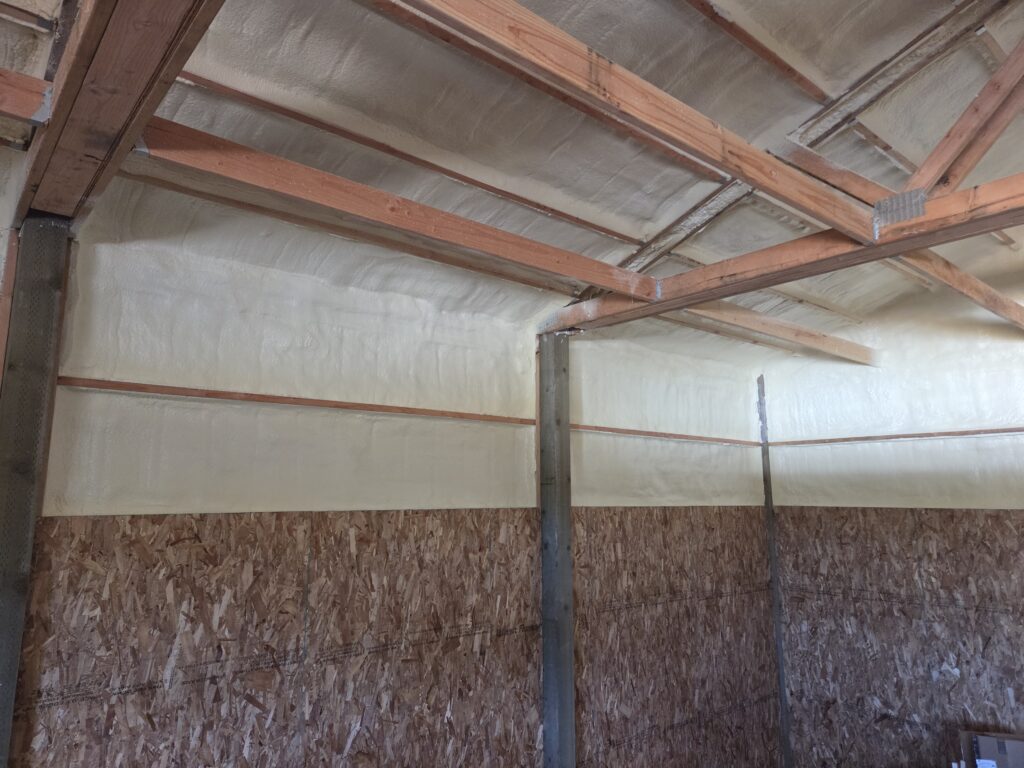
Is spray foam a good fit for metal buildings and barns? Yes — closed cell spray foam is a common choice for metal buildings because it adheres directly to metal panels, adds structural rigidity, and prevents the condensation (“sweating”) that’s common in uninsulated metal structures.
Looking for more information?
Tax Credits, Rebates, & Savings – find out what is available in your area from Energy.gov
Recommended Levels of Insulation – brought to you by Energy Star